What Should You Expect From Your Marketing?
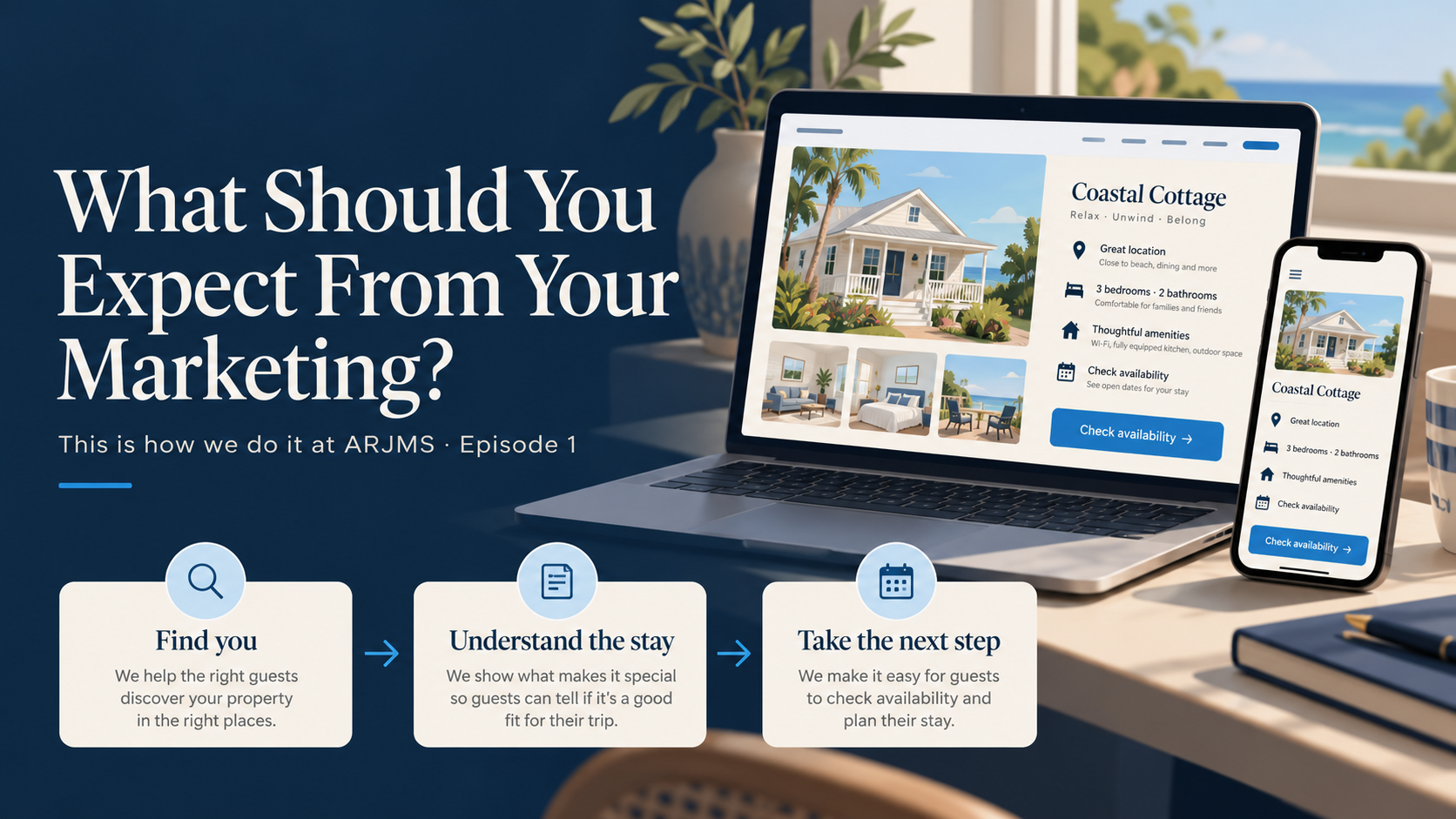
This is how we do it at ARJMS • Episode 1
A new website. A few social posts. A video showing off the property.
All useful tools. But if the expectation is that any one of them will suddenly fill your calendar, we're starting with a promise marketing probably can't deliver.
Marketing doesn't control why someone takes a trip. It doesn't control whether their dates work, whether your property fits their group, or whether the price makes sense to them.
What it can do is help the right guest understand what you offer and take the next step with less confusion.
That's where we begin at ARJMS.
A website is a starting point
Having somewhere guests can book directly matters. But once the website exists, there are still questions to answer:
- How does a potential guest find it?
- What makes them interested enough to stay?
- Can they tell whether the property fits their trip?
- When they're ready, is the next step obvious?
A website can look beautiful and still leave those questions unanswered.
Imagine a guest clicks a photo of a particular home. The link takes them to a homepage with several properties, and they can't tell which one caught their attention. Now they have to start searching again.
That's a hypothetical example, not a finding about a particular client. But it illustrates something worth checking: did your content earn their attention, only for the next step to make things harder?
Before producing more content, look at where you're sending people.
Direct bookings don't mean abandoning OTAs
Airbnb, Vrbo, and other online travel agencies can introduce your property to guests who might never have found you otherwise. That's a useful role.
The question is whether you can also build ways for guests to find you and book directly when it makes sense.
Direct bookings aren't free to acquire. Your website, content, advertising, and time all have costs. Judge the approach by what it takes to earn a booking and whether that makes sense for your business, not simply whether it carries an OTA or direct-booking label.
There isn't one percentage of direct bookings that every owner should expect. Your destination, portfolio, guest mix, and resources matter.
Try this before spending more on traffic
Open your website on your phone. Better yet, ask someone unfamiliar with your business to help.
Give them your business name and watch them find the website. Don't coach them.
Once they arrive, ask what they think you offer and where the properties are. Then give them a realistic group size and dates your property could accommodate. Ask them to find a suitable property and show you how they would check availability.
Stop before they submit a reservation or payment. This is an observation exercise, not a test booking.
Watch for four things:
1. Does the property information answer their questions?
A group needs to understand sleeping arrangements. Someone arriving late needs to know where to find arrival-planning information. Keep private access codes private, but make useful planning details easy to find.
2. Is the next step obvious?
If checking availability means hunting around the page, note it. Something obvious to you may not be obvious to a first-time visitor.
3. What happens when their dates don't work?
Is unavailability clear? If alternatives appear, are they genuinely suitable for that trip?
4. Can they understand the price and terms?
Before committing, can they review the total and important booking terms? Look at what the booking path actually shows rather than assuming those details are there.
Fix one real obstacle
Write down what you observed. Separate an actual problem from a personal preference.
"I don't like that color" is different from "I couldn't find where to check my dates."
Pick one improvement: a clearer description, a more relevant link, corrected information, or a question for whoever manages your booking system.
Make the change. Then ask someone to try the same step again. Did it help?
You don't have to rebuild everything today.
That's the expectation for this series: specific improvements, practical exercises, and attention to the guest's actual decision. You won't need to contact us to get the useful part.
A website gives you somewhere to begin. Today, make sure a guest can use it.
